


We all want something more when we’re told that we can’t have it. Slather on all the good manners you want, this is lizard brain-level stuff. If you don’t notice that “I’ll show you” thought intrude whenever scarcity bias meets reactance, you’re not enlightened—you’re just really good at not paying attention. Here are the concepts in a nutshell: Scarcity bias is why everyone secretly wants the last slice of pizza—and why being the first to say “no, you have it” scores low-key social bonus points. Reactance is why we all feel the urge to fight back when we feel like The Man is taking away our freedoms.

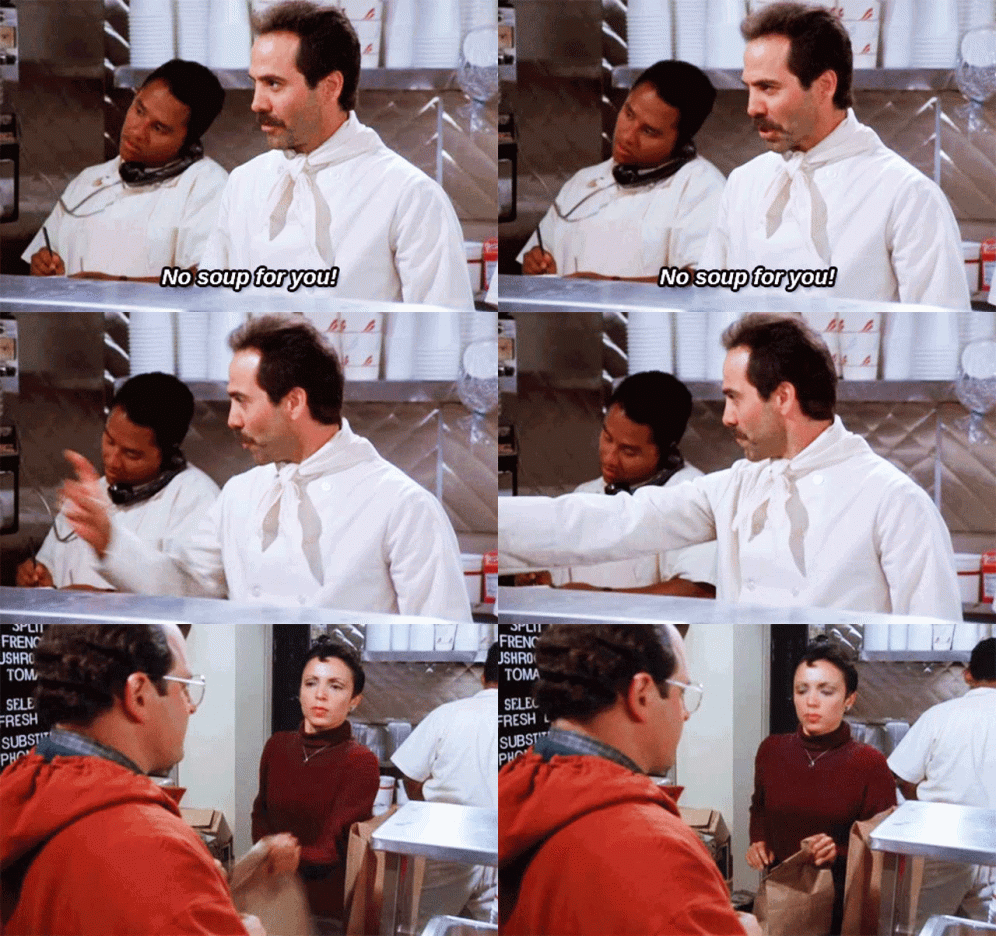
This bit of shared human hardwiring is why everybody who doesn’t hate Seinfeld on general principle loves “The Soup Nazi” (Season 7, Episode 6). It’s a masterclass in scarcity and reactance. The guy with the best soup in town is a tyrant who runs his business with military precision—those who follow his rigid ordering protocol are rewarded, while anyone who dares disrupt the system is banished. Elaine, unbothered by hierarchy, ultimately topples his empire with the one thing more powerful than exclusive access: freedom of information. It's a perfect little parable—how power based on manufactured scarcity is fragile in the face of a motivated populace. A message in a bottle from 1995 labeled “break glass in case of oppression.”
In a democracy, the right to vote is the best soup in town. Suffrage soup is available to any citizen, but you’ve gotta follow the bureaucratic process to get your serving. Back in 1993, Congress passed the National Voter Registration Act (NVRA) to increase voter registration, enhance election integrity, and make the voting process more accessible. It required states to offer voter registration opportunities at DMV offices, public assistance agencies, and by mail, removing barriers that disproportionately affected low-income and marginalized communities.
The legislation worked as advertised: registering to vote got easier. Sure, some states drug their feet on compliance. A few states even tried to water down the federal law by tacking on their own proof of citizenship requirements—like Arizona in 2004—but the Supreme Court struck that nonsense down in 2013. Yet somehow, convenience didn’t translate to increased participation. Voter registration fluctuated between 66-70% of the voting-age population before NVRA went into effect and 68-72% after.
But while registration became more accessible, new tactics emerged to limit who could actually stay on the rolls.
The NVRA also set standards for maintaining voter registration lists, aiming to prevent wrongful purges while ensuring accurate records. Between 2016 and 2018, at least 17 million voters were removed from rolls nationwide, a trend that intensified following the 2013 Supreme Court decision in Shelby County v. Holder, which weakened protections against discriminatory voting practices. Additionally, between 2020 and 2022, over 19 million voters were purged across ten states, accounting for approximately 8.5% of the registered U.S. electorate. These figures suggest an upward trajectory in voter purges, particularly in jurisdictions with histories of voter discrimination.
Sure, voter rolls need regular updates—people move, die, or become ineligible. But not at this scale. A little over 1% of the voting-age population dies each year, and felony disenfranchisement varies by state, affecting a small but inconsistent percentage of voters. But when you consider that the Brennan Center, Heritage Foundation, and Brookings Institution studies all agree that actual voter fraud is negligible in the 21st century, it’s hard to see an 8.5% purge as anything other than the dirty tricks outlined in this detailed analysis by forensic economist Greg Palast.
And now, rather than just purging voters after the fact, the 119th Congress of sock puppets beholden to the wealthy elite is taking aim at who can register in the first place by introducing the Safeguard American Voter Eligibility Act (SAVE Act). Do you see why this manufactured scarcity is triggering my Seinfeld callback reflex?
The SAVE Act aims to require individuals to provide proof of U.S. citizenship, such as a birth certificate or passport, when registering to vote in federal elections. Critics argue that this requirement could disenfranchise millions of eligible voters, particularly married women who have changed their surnames, as the Act does not account for name changes due to marriage. Supporters of the bill contend that it is designed to prevent voter fraud by ensuring that only U.S. citizens can register to vote—solving a problem that barely exists. They say legit citizens don’t need to worry because the Act includes provisions for individuals to provide additional documentation, such as a marriage certificate, to resolve discrepancies between their legal name and citizenship documents.
It’s like we’re living in the worst possible version of Casablanca, a movie about sexy smoking and the importance of having the right pieces of paper at the right time. After weeks of ICE raids on pretexts as thin as speaking Spanish or, seemingly, just being brown, plenty of US citizens are learning the hard way that a driver’s license isn’t enough to prevent humiliating questioning and detainment. Even Native Americans—you know, the people who were here first—are being advised by tribal leadership to carry their Certificate of Indian Blood.
For more than fifty years, movies and TV have used “papers, please” interactions to tell us who to root for. Spoiler alert: it’s never the person demanding the papers. This trope works because it triggers our reactance. We humans are made to root for the oppressed, so it’s no wonder the SAVE Act sparked vocal opposition. It’s not okay to expect some—but not all—people to present both their birth and marriage certificates at the local DMV, just because they’re women who want to exercise their right to vote. Bureaucratic obstacles to any citizen’s right to vote are a clear limitation of freedom. All the worse when they disproportionately burden some voters over others.
I’ll be honest—I was skeptical when the SAVE Act first popped up in my daily information diet. People I trust were sounding the alarm, but I did my usual digging before going off half-cocked and found that a passport is sufficient proof of citizenship. My wife and I keep ours up to date—not because we expect to flee an authoritarian regime at a moment’s notice, but because we like to travel. Sure, it’s bullshit that she’ll have to bring her passport to the DMV while I won’t, but her voting rights aren’t at risk. She tackled the paperwork gauntlet years ago, reissuing her passport in her married name so we could honeymoon in Aruba.
And that’s when it hit me—my experience isn’t universal. If you caught onto my privilege earlier, congrats; you got there faster than I did. It took conversations with people I respect, people with different backgrounds and different bureaucratic battles, for me to recognize the blind spot. If you don’t have friends like that, go make some. You’ll be better for it.
Because here’s the real takeaway: every US citizen is entitled to a passport. It’s not free, but as unconstitutional poll taxes go, it’s relatively cheap. We should absolutely fight to protect universal suffrage, but we can only do that if we hang onto—and actually use—the voting rights we’ve got.
This is the part where I mention that actual voting tends to lag 10-15% behind those registration figures I shared above. It fluctuates independent from registration, so there’s more to getting the vote out than just maintaining the right to do it. Comprehensive and finalized statistics on the 2024 election aren’t available yet, but preliminary data indicates nearly 80% registration and only 63% participation. I don’t have data to back this up, but I would swear more people posted on social media about the candidates than actually voted.
Here’s where the elite fumbled: making it harder for citizens to vote combines scarcity bias and reactance—and that only makes me more determined to fight back. Instead of feeling cowed, my “I’ll show you” mode has been activated. I want to keep my rights, and I want to use them. More importantly, I want you to keep and use your rights. So I put together a quick voter protection guide, which you’ll find at the end of this article.
Get your papers together, people. Talk about this with your friends. Talk about it loudly in public places, so that other people start talking about it. If you’ve got the means, get a passport. Then spend some of your time—and your money, if necessary—helping someone else get their passport. Throw a tailgate in the DMV parking lot while you all update your voter’s registration. Invite your friends over for a research and discussion party while you fill out your practice ballots in preparation for the 2026 midterm elections.
When Elaine gets banned for life by the Soup Nazi in Seinfeld, she finds the secret recipes and uses that information to gain the upper hand and beat him at his own game. When Ugarte gets arrested by the real Nazis in Casablanca, he protests: “But think of all the poor devils who can't get the exit visas! I try to help them.”
Release the recipes. Help the poor devils. We’ve got work to do.

Voter Protection Guide
How to Ensure Your Legal Name & Address Match Across All Records
📌 Step 1: Identify Your Official Legal Name
Your legal name is the name recognized by the most recently issued official government document. To determine yours, check the following in order of priority:
💚 U.S. Passport (if applicable)
💚 Social Security Administration (SSA) Records
💚 Driver’s License or State ID
💚 Voter Registration
If these match, you’re all set! If there are discrepancies, proceed to Step 2.
📌 Step 2: Verify & Update All Government Systems of Record
To prevent registration issues, ensure your legal name and address exactly match across these databases. If updates are needed, follow the linked instructions for each system.
✅ 1. U.S. Passport (Strongest Proof of Citizenship & Identity)
📌 Why? A passport is definitive proof of both citizenship and legal name for federal identity verification.
💚 Check: Look at your most recently issued passport.
🔗 Update Here: U.S. Passport Name Change & Renewal
📞 Phone: 1-877-487-2778 (U.S. State Department)
📄 Physical vs. Digital? Only a physical passport book or card is legally recognized. Digital scans are not valid proof.
📃 How to Get a New or Updated Passport:
Fill out Form DS-11 (New) or Form DS-82 (Renewal).
Provide passport-quality photo.
Submit proof of name change (marriage certificate, divorce decree, court order).
✅ 2. Social Security Administration (SSA)
📌 Why? The SSA is a foundational identity source; name mismatches here can cause cascading issues.
💚 Check: Log in to SSA.gov to verify your record.
🔗 Update Here: SSA Name Change & Replacement Card
📞 Phone: 1-800-772-1213
📄 Physical vs. Digital? A physical Social Security card is required for many legal purposes, but SSA records are accessible digitally.
📃 How to Get a New or Updated Social Security Card:
Fill out Form SS-5 (Download Here).
Provide proof of identity (Passport, Driver’s License, or State ID).
Submit proof of name change (marriage certificate, divorce decree, court order).
✅ 3. Driver’s License or State ID
📌 Why? Most voter registration databases rely on DMV records to verify identity.
💚 Check: Look at your license or state ID to ensure it matches your SSA record.
🔗 Find Your State DMV: DMV.org
📞 Phone: Varies by state (Find DMV Contacts)
📄 Physical vs. Digital? A physical ID is required for voting in most states. Some states offer mobile driver’s licenses, but adoption is limited.
📃 How to Get a New or Updated License/ID:
Bring proof of identity (Passport, Social Security card, or Birth Certificate).
Provide proof of name change (marriage certificate, divorce decree, court order).
Submit proof of address (utility bill, lease, or mortgage statement).
✅ 4. Voter Registration
📌 Why? Ensuring your legal name and address match prevents registration issues under the SAVE Act.
💚 Check: Verify your voter record at nass.org/can-I-vote.
🔗 Update Here: State-by-State Voter Registration
📞 Phone: Contact your state election office (Find Here)
✅ 5. IRS & State Tax Records
📌 Why? While not required for voting, tax records should reflect your correct legal name to prevent inconsistencies.
💚 Check: Your tax return name must match your SSA record.
🔗 Update Here: IRS Name Change & Address Update (Form 8822)
📞 Phone: 1-800-829-1040
🔧 FAQ: Common Issues & Solutions
1. What if my birth certificate doesn’t match my legal name?
📌 You do not need to change your birth certificate. Your passport, Social Security record, and driver’s license are more authoritative proof of your legal name.
2. What if I don’t have a passport?
📌 A passport is the only single federally recognized identity document that establishes both name and citizenship for voter registration and other legal purposes.
3. What if my birth certificate and Social Security card names do not match?
📌 This is common due to name changes. Carry supporting documents such as:
Certified Marriage Certificate
Divorce Decree
Court Order for Name Change
4. What if I can’t afford to update my documents?
📌 Contact:
📢 Final Step: Verify Everything & Register Early!
✅ Confirm legal name & address match across all records.
✅ Register to vote or update registration at nass.org/can-I-vote.
✅ If denied registration due to a mismatch, seek legal help:
📞 Election Protection: 866-687-8683 | 866ourvote.org
📞 ACLU Voting Rights Project: aclu.org/issues/voting-rights
Creative Process Transparency: This piece was collaboratively developed using AI for structural refinement and drafting (30%), with final argumentation, rhetorical framing, and revisions by the author (70%).
Love this, Bradley D!
Wonderful as always. Truly.